
French Plateau: Why Intermediate Learners Stall
Reviewed against editorial standards
Bonjour ! Amélie here. 👋
The French plateau is real, and it is fixable.
If you feel stuck at intermediate French, I want to begin with the kindest possible diagnosis: you are probably not lazy, broken, too old, or secretly bad at languages. You have reached the French plateau, which is less a wall than a training mismatch.
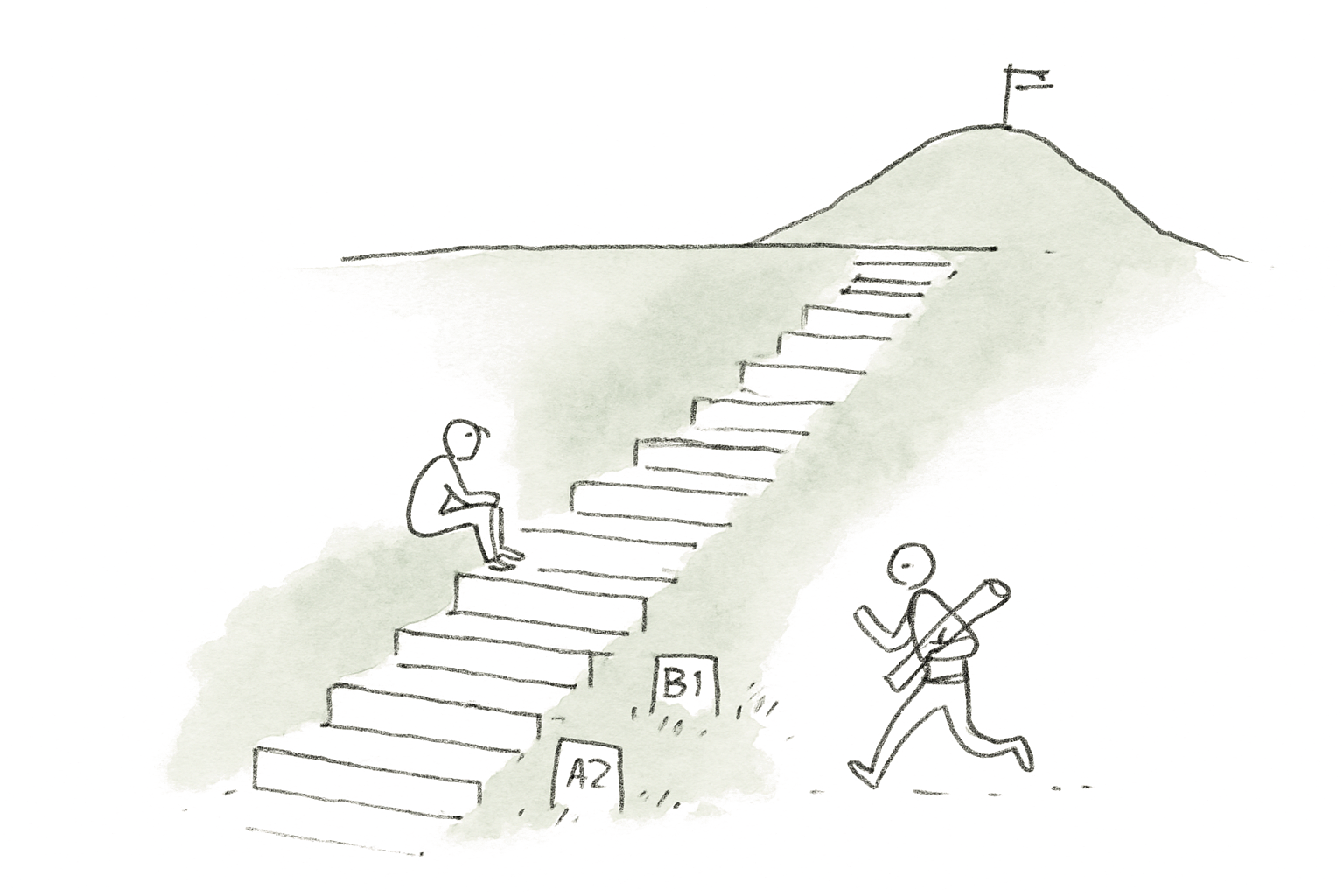
At A1 and A2, progress is visible. You learn the past tense. You order a coffee. You understand a menu. You discover that préservatif does not mean preservative, recover emotionally, and continue.
Then B1 arrives. You know quite a lot. You can read. You can follow your teacher. You can explain your weekend if nobody rushes you. But real French people still sound fast, blurry, and suspiciously allergic to the words you learned.
The short answer: The French plateau happens because intermediate learners keep adding grammar and vocabulary, while their real bottleneck is speed, listening, and automatic recognition. The way out is not starting over. It is targeted practice with short real audio, transcripts, spoken contractions, and regular measurement.
Why do learners get stuck at intermediate French?
Because the problem changes.
In the beginning, you need basic grammar, high-frequency vocabulary, and the courage to open your mouth. A lot of learning is additive: more verbs, more nouns, more sentence patterns.
At intermediate level, the work becomes less visible. You are not only learning new French. You are making the French you already know faster, more automatic, and more flexible.
This is why the plateau feels so unfair. You may study for a month and not see a shiny new milestone. But under the surface, your brain is building speed: recognising a verb before the sentence has moved on, hearing a contraction without translating it, recovering after a missed word.
That work is real. It just does not arrive wearing a badge that says “Congratulations, you unlocked B2.”
Why does B1 French feel so frustrating?
B1 is the level where you can do many things slowly, but real life does not always agree to be slow.
You can understand written French because the words are visible. You can understand your teacher because your teacher is probably speaking clearly, choosing known vocabulary, and quietly protecting you from chaos.
Then you hear two native speakers. Suddenly je ne sais pas becomes chais pas. Il y a becomes y a. The negative ne disappears. Du coup appears everywhere, doing ten small jobs in the conversation.
Nothing is wrong with your French. You learned the full written form. Now your ear needs the spoken form.
This is the plateau in one sentence: your eyes are B1, your ear is still catching up.
Is the French plateau a grammar problem?
Sometimes, but not usually the way learners think.
Yes, grammar still matters. You need tenses, pronouns, connectors, agreement, and sentence structure. But many intermediate learners respond to listening trouble by buying another grammar book. That can help if your grammar is truly weak. It will not automatically make native speech clear.
Imagine someone says:
Chais pas c’qu’y a, mais y a un truc bizarre.
On paper, the full version might be:
Je ne sais pas ce qu’il y a, mais il y a quelque chose de bizarre.
You may know every grammar point in that sentence. Still, if your ear has never trained the compressed sound, you miss it.
So yes, patch grammar holes. But do not hide inside grammar because listening feels messy. The plateau usually needs ear training, not another perfect notebook page.
What should you stop doing when you feel stuck?
Stop measuring progress only by how much new material you finish.
Finishing another app unit, another chapter, or another list can feel productive. Sometimes it is. But if your problem is spoken comprehension, more controlled exercises may simply make you better at controlled exercises.
Also stop restarting. This is a classic plateau habit. Learners think, “Maybe I never learned the basics properly,” then return to beginner material for comfort. A little review is fine. Living there is not.
You do not need to become A1 again. You need to make B1 usable at speed.
What is the concrete way out of the French plateau?
Use a three-part plan: diagnose, train, widen.
First, diagnose. Before changing everything, find the bottleneck. Is it speed? Vocabulary? Spoken contractions? Accent? Confidence? Take a listening test and write down what felt difficult. Vague frustration is hard to fix. A named problem is much friendlier.
Second, train with short audio and transcripts. Choose a short piece of French, ideally a dialogue. Listen once without reading. Then read the transcript while listening. Mark the exact places where the sound surprised you. Listen one final time without the transcript.
Third, widen slowly. Add native podcasts, French TV with French subtitles, radio, or YouTube. But keep the dose small enough that you can return tomorrow. Ten focused minutes beats one dramatic hour followed by avoidance.
The goal is not to understand everything. The goal is to recover faster, catch more on first listen, and stop panicking when the sentence is not perfectly shaped.
How can you train your ear without getting overwhelmed?
Keep the audio short and repeat it shamelessly.
A strange thing happens when learners move beyond beginner French: they think repetition is beneath them. It is not. Repetition is how the sound becomes recognisable.
Try this with one dialogue:
- Listen once for the situation only.
- Listen again and write the words you caught.
- Read the transcript and underline what your ear missed.
- Replay the missed lines three times.
- Listen once more without reading.
If you do this for ten minutes most days, you are training the exact skill the plateau exposed.
And please use a notebook, but a small one. Do not create a museum of French. Write the forms that fooled your ear: chais pas, j’suis, t’as, y a, quand même, en fait, du coup. These are little keys. You do not need 400 of them before dinner.
Should you use podcasts, apps, classes, or a tutor?
Use them for the job they are good at.
Apps can keep vocabulary active and habits alive. Classes can give structure and social accountability. A tutor can help you speak, correct patterns, and build confidence. Clear intermediate podcasts are excellent for volume.
But if you are stuck because native conversation sounds blurry, make sure your week includes real spoken French with support. Support means transcripts, notes, repetition, and someone explaining why je ne sais pas did not sound like je ne sais pas.
That is why French with Amélie is built around colloquial dialogues. Free subscribers get a new dialogue every week. Premium adds 2 full lessons a week, the private podcast, and the 220-lesson library.
It is not magic. It is targeted practice. Much less glamorous than magic, sadly, but more reliable.
How long does it take to break through the French plateau?
Usually weeks to notice movement, months to feel transformed.
The first signs are small: you catch y a without thinking. You stop being shocked when ne disappears. You understand the topic before reading the transcript. You miss a word but do not lose the whole sentence.
That is progress.
Intermediate learners often wait for a cinematic breakthrough. In reality, your ear improves by collecting tiny recognitions until native speech stops feeling like a single locked sound.
If you are on the plateau now, do not restart. Change the training.
Start learning today for a new real French dialogue every week, and take the free listening test so your next plan starts with evidence, not vibes.
Bon courage. The plateau is not proof that you have stopped learning. It is proof that the next skill has announced itself. 💜

About Amélie Laurent
What is French with Amélie?
Finally understand real spoken French, with a teacher in it with you.
- 💬 2 Full Lessons a week, with Amélie's annotated vocab notes
- Every dialogue at native speed, 🐢 Slow Audio and ⚡ À la parisienne
- 💜 The Private Podcast: 220 episodes with Live Transcript, in your podcast app
- 📚 The 220-Lesson Library, with member-only series like Hot Issues 🔥 and Vivre en France 🥖
- ✅ Monthly Level Tests that track your climb
- A real teacher: Amélie writes every dialogue herself
Expressions mentioned in this guide
In this cluster
- Start here: Why Can't I Understand Spoken French? A Teacher Explains
- French Listening Practice: 20-Minute Method
- How French People Actually Speak: Textbook vs Real French
- Chais Pas Meaning: Why French People Say It
- How Long from B1 to B2 French? The Honest Answer
- French Filler Words: The 14 Sounds You Hear in Every Conversation
- Why Do French People Talk So Fast? What Your Ear Is Actually Missing