
How Long from B1 to B2 French? The Honest Answer
Reviewed against editorial standards
Bonjour ! Amélie here. 👋
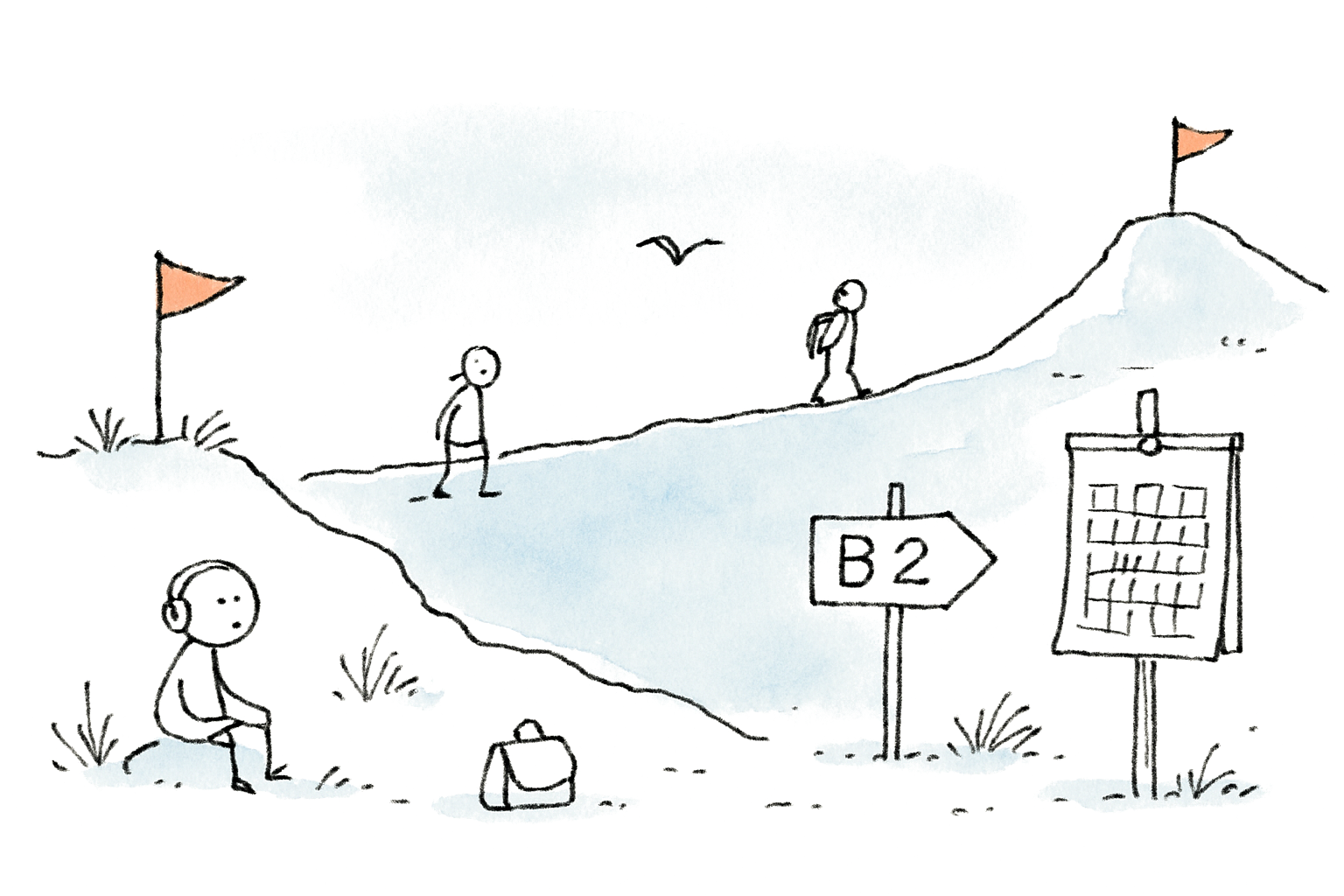
If you are asking how long from B1 to B2 French, I will give you the honest teacher answer: usually months, not weeks, and the timeline depends less on how many grammar pages you complete than on whether you train real spoken French consistently.
The short answer: Moving from B1 to B2 French commonly takes several months of focused work. If you study most days and target listening, speaking, and vocabulary in context, six to twelve months is a realistic planning range for many adults. If your listening is already strong, it can be faster; if it is the weak point, plan longer.
Why does B1 to B2 feel slower than A1 to B1?
Because the early levels reward visible progress.
At A1, you learn bonjour, numbers, food, directions, the present tense, the past tense. Every week feels visible.
At B1, you already know a lot. You can read simple articles. You can travel. You can explain an opinion if people give you time. You can probably understand your teacher.
Then you listen to two native speakers talking normally and suddenly feel like someone changed the locks.
This is the intermediate plateau. It is not that you stopped learning. The next improvements are less visible. You are building speed, automaticity, nuance, and tolerance for not understanding every word.
That work matters, but it does not always sparkle on Monday morning.
What does B2 actually require?
B2 is not “knows lots of French words.” It is more like: can function when French is not carefully arranged for you.
At B2 on the Council of Europe scale, you should be able to follow the main ideas in extended speech, understand a range of registers, explain a viewpoint, defend an opinion, and recover when you miss something. You still make mistakes. You are not magically Parisian after breakfast.
But you are no longer dependent on perfect classroom French.
That is why the B1 to B2 jump so often becomes a listening problem. A learner may pass written exercises and still struggle in ordinary speech because spoken forms are compressed:
je ne sais pas becomes chais pas, il y a becomes y a, and du coup appears everywhere as a connector, filler, and little conversational hinge.
If your ear cannot recognise those forms quickly, your level on paper and your level in conversation will feel like two different people.
How long should you plan for?
For many serious adult learners, I would plan on six to twelve months from B1 to B2.
Three things change the timeline:
- How strong your listening is now.
- How often you practise with real spoken French.
- Whether you get feedback on your output.
If you study 20 minutes twice a week, the move will be slow. If you study most days, listen actively, review transcripts, speak or write regularly, and measure your level, you have a much better chance of visible progress within months.
The learner who only “does more French” often stays stuck. The learner who diagnoses the bottleneck usually moves.
Take the free 3-minute listening test before you build your plan. It gives you a cleaner baseline than vibes.
Why is the intermediate plateau usually a listening problem?
Because listening speed exposes everything.
When you read, weak vocabulary slows you down. When you listen, it can erase the whole sentence. A grammar gap is annoying on paper; in speech, the speaker is already gone.
This is why many B1 learners say:
“I understand written French.”
“I understand my teacher.”
“I understand learner podcasts.”
“But French people talking to each other? Non.”
That gap is exactly where B2 lives. The fix is not only harder material; it is native-style speech with support. Dialogues are especially useful because real conversation is not a monologue.
What should your B1 to B2 plan include?
A realistic plan needs four lanes.
First, active listening. Short audio, transcript, replay. Listen once without help, once with the transcript, once again without it. Mark exactly where your ear failed.
Second, spoken-form vocabulary. Do not only learn fancy nouns. Learn the small high-frequency things French people actually say: bah, ben, en fait, quand même, du coup, j’sais pas, y a, t’as vu. These make speech intelligible.
Third, output. Speak or write a little every week. You do not need to perform. You need to retrieve French from memory often enough that it becomes less theatrical.
Fourth, measurement. Retest monthly or every six weeks. B2 progress can feel invisible if you only ask, “Do I feel fluent yet?” You need smaller signals: more phrases caught on first listen, fewer transcript surprises, faster recovery after unknown words.
Which resources are useful at this stage?
Different tools solve different problems.
Grammar books and Kwiziq-style drills are useful if your sentence structure is shaky. Keep them. B2 does require accuracy.
InnerFrench-style podcasts are useful for comfortable intermediate listening and ideas explained clearly. They are a good bridge, especially if native material still feels too brutal.
Tutors or classes are useful for accountability and correction, provided you also spend enough time with unscripted or semi-scripted French.
Apps can keep your streak alive, but they should not be the centre of a B1 to B2 plan. At this stage, your ears need more than correct taps.
French with Amélie sits in the middle: realistic dialogues, native, slow, and fast audio, transcripts, annotated notes, and monthly level tests. Free readers get one dialogue a week; members get 2 full lessons a week and the 220+ lesson library by level and topic.
Start learning today — one real French dialogue every week →
What would I do for the next twelve weeks?
Weeks 1-2: baseline. Take the listening test, choose B1/B1+ audio, and identify your biggest issues: speed, vocabulary, contractions, accent, or confidence.
Weeks 3-6: controlled listening. Repeat short dialogues until you can hear the spoken forms clearly. Keep a notebook of the reductions that fooled you.
Weeks 7-10: wider input. Add native podcasts, French TV with French subtitles, or radio segments. Keep them short.
Weeks 11-12: retest and adjust. If your listening improved but speaking feels blocked, add more output. If speaking improved but audio is still foggy, stay in the listening lane longer.
This is clinical, not glamorous. It is also how adult learners make real progress.
What do learners ask me most?
Can I go from B1 to B2 French in three months?
Possibly, if you already have strong listening and can study seriously most days. For many learners, three months is enough to make clear progress, but not enough to consolidate B2 comfortably.
Do I need B2 grammar before I listen to native French?
No. Start listening now, with support. Waiting until your grammar is perfect is a beautiful way to stay stuck forever.
How do I know when I am B2?
Use a real measuring stick: listening tests, writing or speaking feedback, and your ability to understand longer native speech without collapsing after every unknown word. Start with the free listening test →
Bon courage — B1 to B2 is not a wall. It is a long staircase, and the next step is usually your ear. 💜

About Amélie Laurent
What is French with Amélie?
Finally understand real spoken French, with a teacher in it with you.
- 💬 2 Full Lessons a week, with Amélie's annotated vocab notes
- Every dialogue at native speed, 🐢 Slow Audio and ⚡ À la parisienne
- 💜 The Private Podcast: 220 episodes with Live Transcript, in your podcast app
- 📚 The 220-Lesson Library, with member-only series like Hot Issues 🔥 and Vivre en France 🥖
- ✅ Monthly Level Tests that track your climb
- A real teacher: Amélie writes every dialogue herself
Expressions mentioned in this guide
In this cluster
- Start here: Why Can't I Understand Spoken French? A Teacher Explains
- French Listening Practice: 20-Minute Method
- How French People Actually Speak: Textbook vs Real French
- Chais Pas Meaning: Why French People Say It
- French Plateau: Why Intermediate Learners Stall
- French Filler Words: The 14 Sounds You Hear in Every Conversation
- Why Do French People Talk So Fast? What Your Ear Is Actually Missing
- How to Understand French Movies Without Subtitles: A Teacher's 4-Step Method