
French Listening Practice: 20-Minute Method
Reviewed against editorial standards
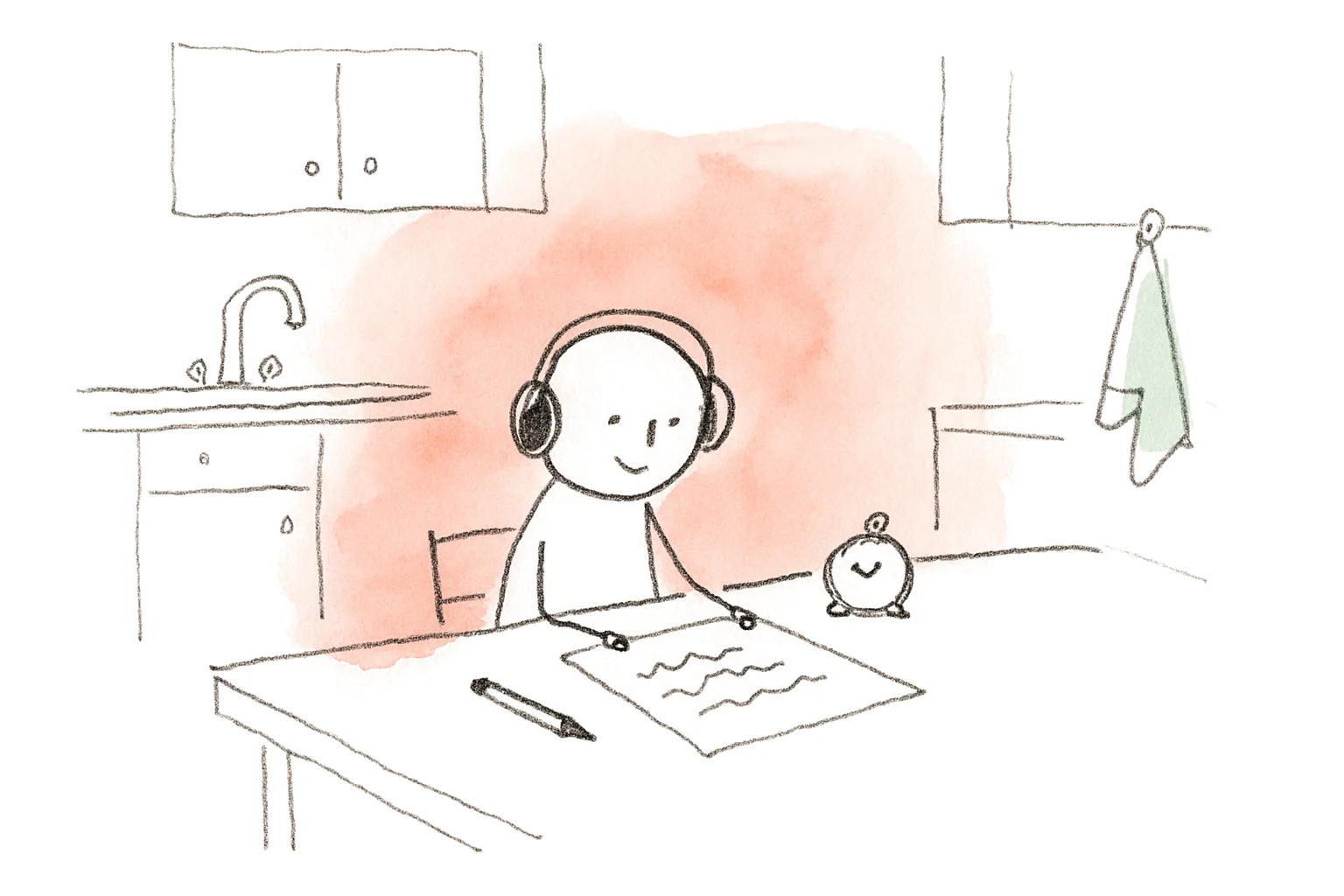
Bonjour. Amélie here. 👋
If your french listening practice mostly means replaying podcasts while doing laundry and hoping your ears become Parisian by osmosis, I have news: the laundry is improving faster than you are.
The short answer: The best French listening practice is short and active: 20 minutes, five days a week, with a few minutes of audio that is hard but not ridiculous. Listen blind, check the transcript, hunt the sounds you missed, listen again without reading, then recall a few phrases. Repeat for a month.
Listening gets better when you make it slightly uncomfortable, then check exactly what happened. Not painfully uncomfortable. Not “I watched a 90-minute political debate and understood the word mais twice.” Just uncomfortable enough that your brain has to connect written French to spoken French.
That is the whole method.
Why you can read French but not hear it
Reading French is tidy. The words stand still. They wear little accents. They wait politely while you inspect them.
Spoken French is a small motorbike going past your window.
You know je ne sais pas, but you hear chais pas. You know il y a, but people say y a. You know de ce fait, then real people say du coup because apparently French needed one phrase to do the work of eight. Between those words sit the fillers, euh, bah, bon, en fait, that cost you attention and carry no meaning; I listed the fourteen that matter in French filler words.
This is not a sign that you are “bad at listening.” It is a sign that written French and spoken French are not the same training problem. I wrote a fuller guide on why you can read French but can’t hear it, but the short version is this: your eyes are ahead of your ears.
So stop treating listening as background ambience. Use a transcript, but use it correctly.
The 20-minute French listening routine
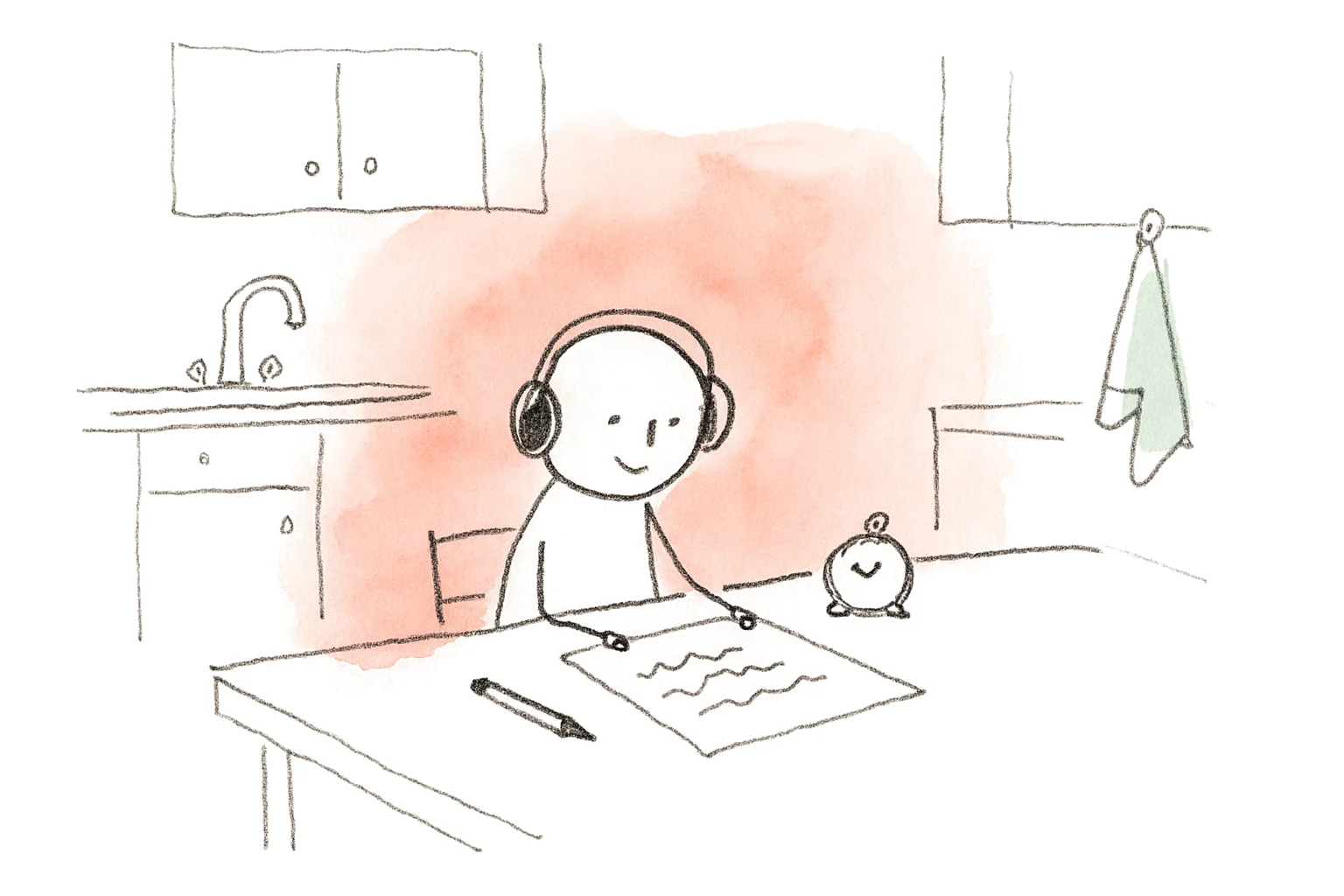
Do this five days a week for one month. Same time, same chair, same slightly dramatic cup of tea.
Minute 0-4: blind listen
Choose audio that is hard but not ridiculous. You should understand the situation, not every word.
Listen once without the transcript. No subtitles. No pausing every three seconds like a nervous court stenographer.
After the first listen, write three things:
- Who is speaking?
- What is the situation?
- Which words or phrases did you catch?
If you caught almost nothing, the audio is too hard. If you caught everything, it is too easy. Annoying, but true.
Minute 4-10: transcript check
Now read the transcript while listening again.
This is where french listening practice with transcript becomes useful. Do not just read it like an article. Your job is to find the gap between the sentence you expected and the sound you heard.
Mark:
- missing words you actually knew
- contractions
- liaisons
- filler words
- dropped ne
- places where several small words became one sound
This is the moment your brain says, “Ah, that was not one mysterious word. That was je suis allé said quickly.” Very satisfying. Mildly irritating. Necessary.
Minute 10-15: sound hunt
Choose three lines from the transcript that fooled you.
Replay only those lines. Say them out loud. Not beautifully. Accurately.
You are training your mouth because your ear improves when your mouth understands the movement. If you can produce chais pas, you are more likely to hear it.
Minute 15-18: listen again without reading
Close the transcript. Listen again.
This third listen should feel easier. Not because the audio changed. Because your brain finally has a map.
This is the part most learners skip, which is why they own many transcript tabs and still panic when the waiter speaks.
Minute 18-20: tiny active recall
Write five phrases you want to remember. Not single words. Phrases.
Bad: coup.
Better: du coup, on fait quoi ?
Single words are lonely. Phrases know how to behave in public.
Free French listening resources by level
Here is the honest ladder. Use free resources first. Pay later only if the paid tool solves a precise problem.
A1-A2: clear audio, short tasks, lots of support
Start with TV5MONDE Apprendre. It is free, ad-free, and built around authentic French videos with exercises; TV5MONDE says the platform has more than 4,000 exercises and includes subtitles, transcriptions, corrections, and other learner tools. Good value at the extremely French price of zero euros.
Add Coffee Break French if you like teacher-led audio. The free podcasts are useful for pronunciation and structure; the written materials and full transcripts live mainly in the paid course ecosystem. Coffee Break’s own help page currently lists individual seasons at £150 in the UK or $199 in the US, while the Coffee Break French Club is listed at £18/month.
The Duolingo French Podcast is also useful at upper A2/B1 if you like true stories with English context. Duolingo has sunset its podcast series, but says the archive remains available; the French podcast pages include episode transcripts.
B1: transcripts, monologues, news, then messier speech
At B1, InnerFrench is still one of the best free bridges. The episodes are designed to become progressively more challenging, and episode pages include transcripts after you create a free account. Use it for stamina and clear intermediate French.
For news, RFI Journal en français facile is the classic free option: about ten minutes, Monday to Friday, with transcripts and learner exercises attached to episodes. It is still news French, so do not expect café chaos, but it trains speed and current vocabulary well.
This is also where French with Amélie fits if your problem is real spoken French rather than formal comprehension. It works from A2 up: slow audio, transcripts and translations carry A2 learners, and native-speed dialogues stretch B1–C1. You get short colloquial dialogues, native audio, slow and fast audio in Premium, annotated vocab notes, exercises, the private podcast, and the 220-lesson library. It is not for day-one beginners, learners who only want news, or anyone looking for tutoring.
If you want more options in this lane, see my guide to French podcasts with transcripts and the list of free French dialogues.
B2 and above: native rhythm, fewer safety rails
At B2, you need less “learner French” and more normal French with a way to check yourself.
Easy French is strong here because the format is conversational and rooted in everyday topics. The Easy French team describes its work as authentic video and podcast content, with street interviews and weekly video/podcast production; the paid member extras include transcripts, vocabulary, and exercises. Current Easy French membership tiers on Patreon start at $6.50/month, with a podcast tier shown at $12.50/month.
News in Slow French is worth considering if you specifically want polished slow news. As of this check, Full Access is $22.90/month and includes transcripts, contextual translations, lessons, and quizzes; Audio Only is $6.90/month and does not include transcripts or interactive features. Good for current events. Less good if your goal is understanding two friends interrupting each other over dinner.
At this level, also add native radio, YouTube, films, and series — but keep the same routine. Blind listen. Transcript or subtitles. Sound hunt. Listen again. Your ego will complain. Let it.
How to improve French listening without wasting months
Do not choose resources by brand. Choose by bottleneck.
If you miss words you know on paper, use transcripts.
If you understand one clear speaker but not conversations, use dialogues.
If you understand learner podcasts but not French TV, add native-speed clips with French subtitles.
If you have no idea what your level is, do not guess. Guessing produces very elaborate study plans and very little listening.
Take the free French placement test first. Then choose one resource at your level and use the 20-minute routine for four weeks.
Not ten resources. One.
Your ear does not need more tabs. It needs repeated contact with French sound, followed by the transcript gently pointing at the crime scene.
Bonne écoute. The motorbike will slow down. A little. Enough.

About Amélie Laurent
What is French with Amélie?
Finally understand real spoken French, with a teacher in it with you.
- 💬 2 Full Lessons a week, with Amélie's annotated vocab notes
- Every dialogue at native speed, 🐢 Slow Audio and ⚡ À la parisienne
- 💜 The Private Podcast: 220 episodes with Live Transcript, in your podcast app
- 📚 The 220-Lesson Library, with member-only series like Hot Issues 🔥 and Vivre en France 🥖
- ✅ Monthly Level Tests that track your climb
- A real teacher: Amélie writes every dialogue herself
Expressions mentioned in this guide
In this cluster
- Start here: Why Can't I Understand Spoken French? A Teacher Explains
- How French People Actually Speak: Textbook vs Real French
- Chais Pas Meaning: 'Dunno' (Je Ne Sais Pas, Squashed)
- French Plateau: Why Intermediate Learners Stall
- How Long from B1 to B2 French? The Honest Answer
- French Filler Words: The 14 Sounds You Hear in Every Conversation
- Why Do French People Talk So Fast? What Your Ear Is Actually Missing
- How to Understand French Movies Without Subtitles: A Teacher's 4-Step Method