
French Filler Words: The 14 Sounds You Hear in Every Conversation
Reviewed against editorial standards
Bonjour, Amélie here, French teacher in Paris.
The short answer
French filler words are the small sounds and connectors that hold a sentence together while the speaker thinks: euh, bah, bon, alors, du coup, en fait, genre, quoi, voilà, bref. They carry almost no dictionary meaning, which is exactly why textbooks skip them and why real French sounds so fast. Learn to hear them first. Say three or four of them yourself, no more.
What are French filler words?
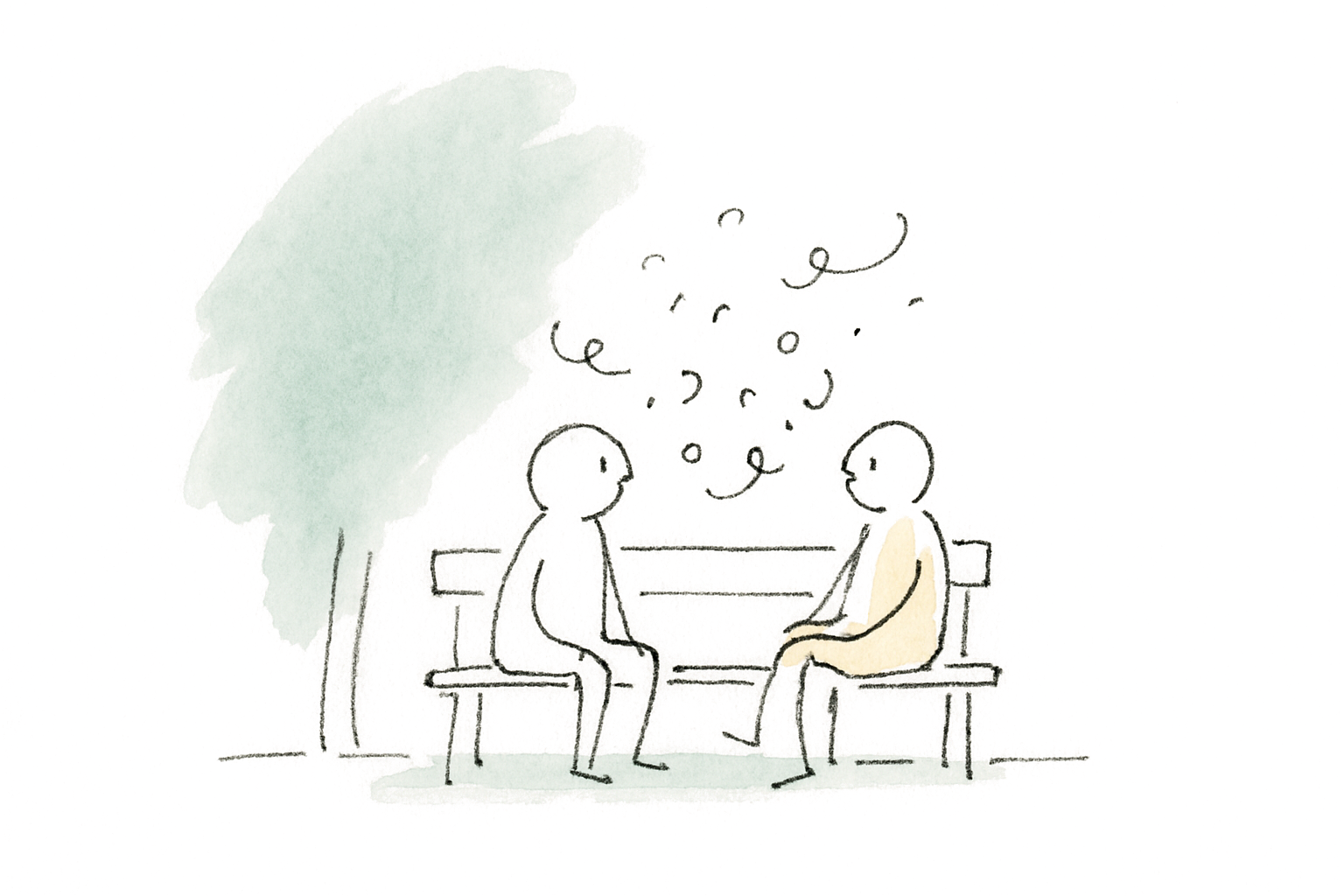
A filler word is anything a speaker says to keep the floor while the next idea arrives. In English you say um, like, you know, so, right. French has the same job to fill, and it fills it with different sounds.
Linguists call them discourse markers. My students call them “the words that are not in my book”. Both are right. A French person speaking at normal speed produces one roughly every sentence, and almost none of them appear in a grammar table.
This matters for listening more than for speaking. When you hear bah euh en fait du coup je sais pas, your brain tries to translate six words. A French ear hears one piece of information, “I don’t know”, wrapped in noise. Once you can label the noise, the sentence shrinks to its real size.
Which French filler words do you hear most?
Here are the fourteen I hear most in Paris, in cafés, offices and my own kitchen. Frequency is my teaching judgment, not a corpus count.
| Filler | Sounds like | What it does | English cousin |
|---|---|---|---|
| euh | “uh” | Pure hesitation. Buys time. | um |
| bah / ben | “bah”, “ban” | “Well, obviously.” Softens or signals the answer is evident. | well |
| bon | “bon” | Closes one thought, opens the next. Often with a sigh. | right, OK |
| alors | “alor” | Starts a sentence while the speaker gathers it. | so |
| du coup | “du koo” | “So, as a result.” Used far beyond its logical meaning. | so, anyway |
| en fait | “on fett” | “Actually.” Often introduces a correction, often means nothing. | actually |
| genre | “jonre” | “Like.” Introduces an example or an approximation. | like |
| quoi | “kwa” | Ends a sentence to say “you see what I mean”. | you know |
| voilà | “vwala” | “There you go, that’s it.” Closes an explanation. | so, there you have it |
| bref | “bref” | “Anyway, to cut it short.” Usually after a long story. | anyway, long story short |
| enfin / fin | “onfan”, “fan” | “Well, I mean.” Corrects or backtracks mid-sentence. | I mean |
| tu vois / tu sais | “tu vwa”, “tu sé” | Checks you are following. | you see, you know |
| hein | “an” | Tag at the end. Asks for agreement or just marks the end. | eh, right? |
| ouais | “way” | Casual yes, also used as a thinking sound. | yeah |
Two more that are not fillers but behave like them: chais pas, the spoken form of je ne sais pas, which people say while they are still deciding, and donc, which has a real logical meaning but gets used as a sentence starter the way so does in English.
What do euh, bah and bon actually mean?
Nothing, and everything. Here is the difference a French ear hears.
Euh is neutral hesitation. It tells you only that the speaker is not finished. Do not fill it with meaning.
Bah has an attitude. It says the answer should be obvious: Tu viens ce soir ? Bah oui. The bah adds “of course”. Said slowly, with a shrug, it can also mean “well, I’m not sure”.
Bon is a hinge. The speaker has finished something and is moving on: Bon, on y va ? Said alone with a falling tone, it means “right, enough of that”.
My students confuse bon and bien for years because the textbook translates both as “good”. In speech, bon at the start of a sentence is almost never about quality. It is about moving on.
Why do textbooks leave filler words out?
Because fillers are not grammar, and because they look like bad French on paper. No author wants to print bah euh genre in a chapter about the passé composé.
Textbooks also tend to teach a written register. In writing, hesitation does not exist. You compose the sentence, you delete the mess, you publish the tidy version. Spoken French never gets that edit. The mess is the language.
The result is a specific learner profile I see every week: strong reading, reasonable grammar, and panic the moment two French people start talking. Half of that panic is fillers. I wrote about the wider gap in textbook French vs real French; fillers are the part of it you can fix fastest.
How do filler words make French sound so fast?
They do not add speed. They add density. A sentence with three fillers has three extra syllables and no extra information, and the fillers arrive at exactly the moments your brain wanted a pause.
There is a second effect. Fillers glue onto neighbouring words. En fait becomes “onfet”, tu vois becomes “tvwa”, enfin shrinks to “fin”. Written French keeps the spaces. Spoken French closes them. If you learned the filler from a list, you may still not recognise it at speed.
The fix is not to listen harder. It is to hear each filler enough times in real dialogue that it stops costing attention. Then you have the attention back for the words that matter.
Should you use French filler words yourself?
Yes, a few. A learner who speaks with zero fillers sounds like a recording. A learner who uses euh instead of um, bon to change topic and du coup once in a while sounds like someone who has lived in French for a bit.
Start with these three.
- Euh instead of um. This is the single biggest accent fix that costs nothing. An English um in the middle of a French sentence marks you instantly.
- Bon to change subject or wrap up.
- Du coup to say “so” when you move to a consequence.
Add en fait when you correct yourself and voilà when you finish explaining something. That is five, and it is plenty.
Avoid two for now. Genre dates you and your register; it is fine among friends under forty and odd elsewhere. Quoi at the end of sentences is very natural and very hard to place correctly; overuse sounds like parody. Listen to both for a year before you adopt them.
Which filler words should you avoid overusing?
Any of them, used every sentence, becomes a tic. French people complain about du coup the way English speakers complain about like. There are newspaper columns about it. Say it, but notice when you say it.
En fait has the same problem. Some speakers start every answer with it. You will hear it; do not copy the habit.
The rule I give students: fillers are seasoning. One per sentence, two at most. Your French should still be mostly food.
How can you practise hearing French filler words?
Not from a list. You have the list now and it will not help you at speed. Three things do.
Listen to dialogue, not monologue. Podcast hosts speaking alone use few fillers because they have prepared. Two people negotiating a plan use dozens. Pick audio where people talk to each other. My French listening practice guide explains how to build that habit without burning out.
Read the transcript once with the fillers highlighted. Underline every euh, bah, bon, du coup, en fait. Then listen again and notice how little of the sentence is left. That exercise alone changes how you hear French.
Shadow one filler a week. Choose bon this week. Every time you hear it, say it back with the same tone. Next week, du coup. In three months you will own the ten that matter.
Every dialogue I publish does this on purpose: real speakers, real fillers, a full transcript, and notes that point at the exact moment je ne sais pas became chais pas. If you want a steady supply, start learning today. And if you are not sure whether fillers are really the problem, the free listening test will tell you in a few minutes what your ear is actually missing.
Bon. Voilà. Du coup, à bientôt. 💜

About Amélie Laurent
What is French with Amélie?
Finally understand real spoken French, with a teacher in it with you.
- 💬 2 Full Lessons a week, with Amélie's annotated vocab notes
- Every dialogue at native speed, 🐢 Slow Audio and ⚡ À la parisienne
- 💜 The Private Podcast: 220 episodes with Live Transcript, in your podcast app
- 📚 The 220-Lesson Library, with member-only series like Hot Issues 🔥 and Vivre en France 🥖
- ✅ Monthly Level Tests that track your climb
- A real teacher: Amélie writes every dialogue herself
Expressions mentioned in this guide
In this cluster
- Start here: Why Can't I Understand Spoken French? A Teacher Explains
- French Listening Practice: 20-Minute Method
- How French People Actually Speak: Textbook vs Real French
- Chais Pas Meaning: Why French People Say It
- French Plateau: Why Intermediate Learners Stall
- How Long from B1 to B2 French? The Honest Answer
- Why Do French People Talk So Fast? What Your Ear Is Actually Missing