
Simple French Conversations for Beginners (with Audio)
Reviewed against editorial standards
Bonjour, Amélie here, French teacher in Paris.
The short answer
A simple French conversation is four to eight short lines about something ordinary: ordering a coffee, buying bread, asking the way, saying what you did at the weekend. Below are eight of them, each with an English translation and notes on how people actually say it, plus three real audio clips. Read one a day, out loud.
Why start with simple conversations?
Because that is where French lives. Most of what you say in France is bonjour, a coffee, a question about the metro, a polite goodbye. Get those easy and everything else has somewhere to stand.
The catch: beginner-book French is correct and slightly unreal. Nobody at my café says Je ne sais pas. They say Euh… chais pas. So each conversation below comes in clean, simple French, then notes on what you will actually hear. Learn the clean version to speak. Learn the notes to understand.
Everything here sits around A2: past the very first basics, short sentences, everyday verbs.
1. At the café
| French | English |
|---|---|
| — Bonjour, qu’est-ce que je vous sers ? | — Hello, what can I get you? |
| — Bonjour, un café, s’il vous plaît. | — Hello, a coffee, please. |
| — Un expresso ? | — An espresso? |
| — Oui, et un verre d’eau aussi. | — Yes, and a glass of water too. |
| — Très bien. Sur place ou à emporter ? | — Fine. For here or to take away? |
| — Sur place. | — For here. |
| — Ça fait deux euros vingt. | — That’s two euros twenty. |
| — Voilà. Merci. | — Here you go. Thanks. |
What people actually say
- Un café in France means an espresso. If you want a big milky coffee, ask for un café crème or un grand crème.
- Voilà is what you say as you hand over the money. It means “there you go”, not “ta-da”.
- To order, je voudrais is perfect and polite. In practice many people just say the thing and s’il vous plaît: Un café, s’il vous plaît. More on ordering on the commander page.
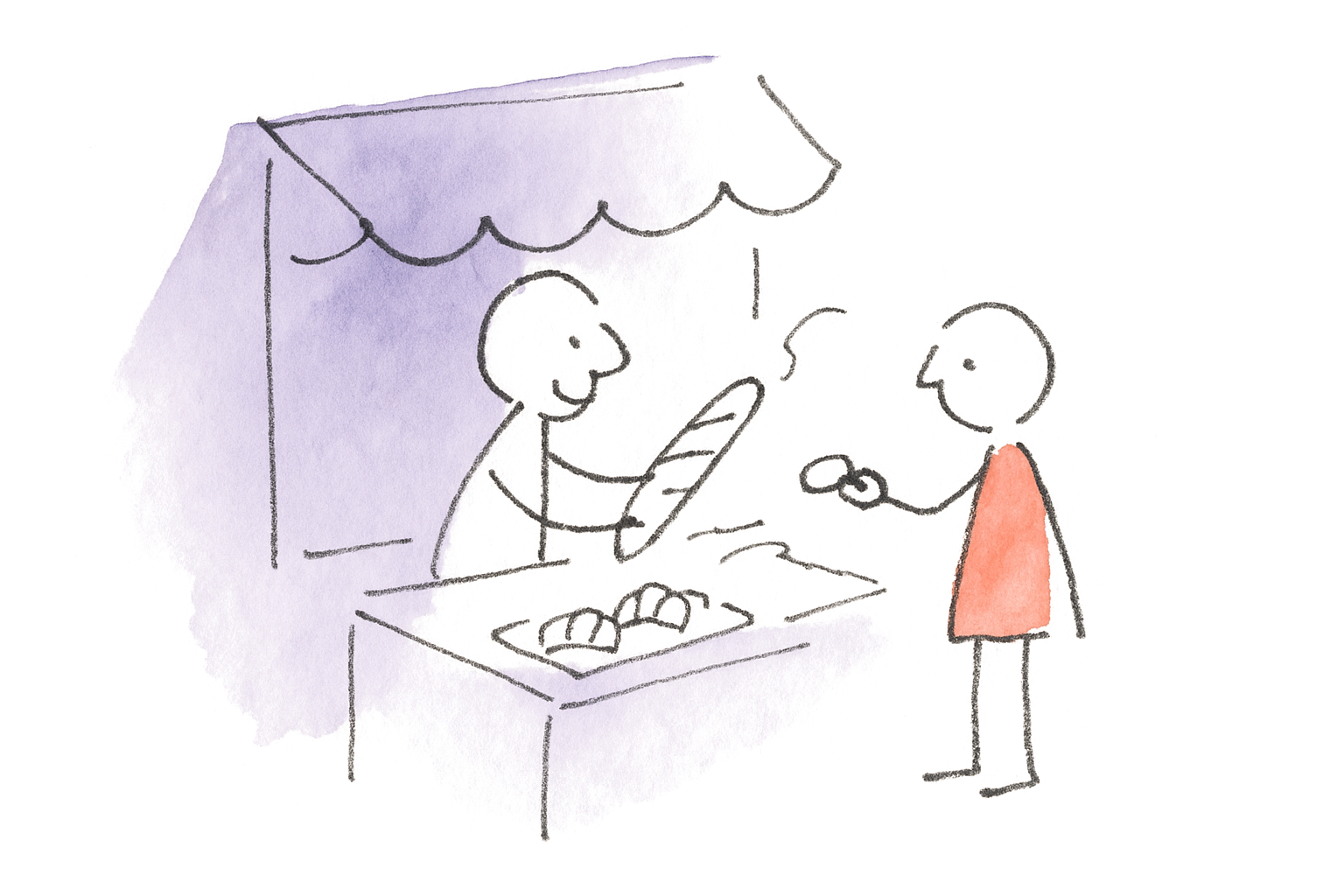
2. At the bakery
| French | English |
|---|---|
| — Bonjour madame. | — Hello. |
| — Bonjour. Une baguette tradition, s’il vous plaît. | — Hello. A traditional baguette, please. |
| — Bien cuite ou pas trop cuite ? | — Well baked or not too baked? |
| — Pas trop cuite. Et deux croissants. | — Not too baked. And two croissants. |
| — Ce sera tout ? | — Will that be all? |
| — Oui, c’est tout. | — Yes, that’s all. |
| — Trois euros cinquante. Bonne journée. | — Three euros fifty. Have a good day. |
| — Merci, vous aussi. | — Thanks, you too. |
What people actually say
- Always open with bonjour. Skipping it is the fastest way to get cold service in France, and it is not the baker being rude.
- Ce sera tout ? often shrinks to Et avec ceci ? (“anything else?”). Answer C’est tout, merci.
- Vous aussi is the standard reply to bonne journée. You will say it ten times a day.
- Outside, first bite of the warm croissant: Miam, the French “yum”. Children double it, miam miam, and so do most adults.
3. Asking for directions
| French | English |
|---|---|
| — Excusez-moi, je cherche le métro, s’il vous plaît. | — Excuse me, I’m looking for the metro, please. |
| — Le métro ? C’est tout droit, puis à gauche. | — The metro? It’s straight on, then left. |
| — C’est loin ? | — Is it far? |
| — Non, cinq minutes à pied. | — No, five minutes on foot. |
| — D’accord, merci beaucoup. | — OK, thanks a lot. |
| — De rien. | — You’re welcome. |
What people actually say
- Excusez-moi is the polite door-opener. Then ask with je cherche… (“I’m looking for…”). It is easier than building a full question.
- D’accord often becomes d’acc or just OK in speech.
- De rien is the default answer to thanks. You may also hear Je vous en prie, which is more formal.
4. Meeting someone new
| French | English |
|---|---|
| — Salut, moi c’est Léa. Et toi ? | — Hi, I’m Léa. And you? |
| — Moi c’est Tom. Enchanté. | — I’m Tom. Nice to meet you. |
| — Tu es d’où ? | — Where are you from? |
| — Je suis anglais, mais j’habite à Lyon. | — I’m English, but I live in Lyon. |
| — Ah, cool. Et tu fais quoi dans la vie ? | — Oh, cool. And what do you do? |
| — Je suis prof. Et toi ? | — I’m a teacher. And you? |
| — Moi, je travaille dans un hôpital. | — I work in a hospital. |
What people actually say
- Moi c’est Léa is how people introduce themselves in real life. Je m’appelle Léa is correct, just a little more formal.
- Enchanté (or enchantée if you are a woman) is “nice to meet you”. People also just say salut and move on.
- Tu fais quoi dans la vie ? is the spoken version of Quelle est ta profession ? Nobody asks the second one at a party.
5. Small talk about the weekend
| French | English |
|---|---|
| — Salut, ça va ? | — Hi, how are you? |
| — Ça va, et toi ? | — Fine, and you? |
| — Bien. Tu as fait quoi ce week-end ? | — Good. What did you do this weekend? |
| — Pas grand-chose. Je suis allé au cinéma samedi. | — Not much. I went to the cinema on Saturday. |
| — C’était bien ? | — Was it good? |
| — Bof, pas terrible. Et toi ? | — Meh, not great. And you? |
| — J’ai dormi. Beaucoup. | — I slept. A lot. |
What people actually say
- Ça va ? / Ça va. is a complete exchange. Question and answer, same two words, different tone.
- Tu as fait quoi becomes t’as fait quoi in fast speech. The tu loses its u.
- Bof is a shrug in one syllable. If something was good, you might hear pas mal, which means “pretty good”, not “not bad”.
6. On the phone
| French | English |
|---|---|
| — Allô ? | — Hello? |
| — Allô, bonjour, c’est Marc. Je voudrais réserver une table pour ce soir. | — Hello, it’s Marc. I’d like to book a table for tonight. |
| — Pour combien de personnes ? | — For how many people? |
| — Pour deux, à vingt heures. | — For two, at eight o’clock. |
| — C’est noté. À ce soir. | — That’s booked. See you tonight. |
| — Merci, au revoir. | — Thanks, goodbye. |
What people actually say
- Allô is only for the phone. Never use it to greet someone in the street.
- French uses the 24-hour clock for bookings: vingt heures is 8 pm. You will also hear huit heures du soir.
- C’est noté (“noted”) is the restaurant’s way of saying you are booked. Another common reply is ça marche, “that works”.
7. At the market
| French | English |
|---|---|
| — Bonjour, elles sont à combien, les tomates ? | — Hello, how much are the tomatoes? |
| — Trois euros le kilo. | — Three euros a kilo. |
| — Je vais en prendre un kilo, s’il vous plaît. | — I’ll take a kilo, please. |
| — Et avec ça ? | — Anything else? |
| — Euh… je sais pas. Elles sont bonnes, les fraises ? | — Um… I don’t know. Are the strawberries good? |
| — Bah oui, elles sont de la région. | — Well, yes, they’re local. |
| — Alors une barquette aussi. | — Then a punnet too. |
What people actually say
- Je sais pas drops the ne. Spoken French almost always does. Faster still, it becomes chais pas. I wrote a whole guide to chais pas.
- Bah (or ben) means “well, obviously”. The seller is not annoyed, just very sure of the strawberries.
- Je vais en prendre uses en to mean “some of them”. You can skip it at first and just say un kilo, s’il vous plaît.
8. At the hotel
| French | English |
|---|---|
| — Bonsoir, j’ai une réservation au nom de Smith. | — Good evening, I have a booking under the name Smith. |
| — Oui, deux nuits. Vous avez une pièce d’identité ? | — Yes, two nights. Do you have ID? |
| — Oui, voilà mon passeport. | — Yes, here’s my passport. |
| — Merci. Chambre douze, au premier étage. | — Thanks. Room twelve, on the first floor. |
| — Le petit-déjeuner est à quelle heure ? | — What time is breakfast? |
| — De sept heures à dix heures. | — From seven to ten. |
What people actually say
- Bonsoir takes over from bonjour in the evening, roughly from 6 pm.
- Au premier étage is one floor above the ground. The ground floor is le rez-de-chaussée.
- Receptionists often say Il y a un ascenseur (“there’s a lift”) as Y a un ascenseur. That y a is everywhere in spoken French.
Hear a real conversation at native speed
Your ear needs its own practice. These three short clips open my free listening test. They are spoken slowly and clearly, the A2 end of the test, and each one is the kind of sentence you would hear in a real chat.
Ce matin, j’ai commandé un cappuccino avec de la cannelle. This morning, I ordered a cappuccino with cinnamon.
Ce matin, j’ai reçu une lettre de mon ami Pierre. Il vit maintenant en Italie, et il a hâte de me revoir. This morning, I got a letter from my friend Pierre. He lives in Italy now, and he can’t wait to see me again.
Ma boulangerie préférée ferme à la fin du mois — les propriétaires prennent leur retraite. Une nouvelle boulangerie va ouvrir à la place… on verra bien. My favourite bakery is closing at the end of the month. The owners are retiring. A new bakery is going to open in its place… we’ll see.
Listen once without reading, then again with the text. Notice how on verra bien (“we’ll see”) lands like a shrug. And mon ami Pierre is the careful version; among friends you would hear mon pote Pierre.
This is how my lessons work at A2. Every dialogue comes with a full transcript, and 💎 Premium adds 🐢 Slow Audio next to the native-speed version, so you can hear each word clearly first and then catch it at real speed.
How to practise these
Five minutes a day beats an hour on Sunday. Here is the routine I give my students.
Read one conversation aloud. Both parts. Out loud, not in your head. Your mouth needs the practice as much as your eyes.
Shadow the audio. Play a clip, pause after each sentence and repeat it with the same rhythm. Do not worry about perfect sounds. Copy the music first.
Swap one detail. Change the coffee to a tea, the metro to the station, Saturday to Sunday. Now it is your conversation, not mine.
Read the notes twice. The clean version helps you speak. The notes help you understand people who do not speak like a book, which is everyone. My guide to French filler words goes further on bah, du coup and friends.
When these feel easy, move on to longer dialogues. I keep a list of free French dialogues with transcripts, sorted by level.
Not sure where you are? The free level test takes about two minutes and tests your ears, not your grammar. And if you want a new conversation in your inbox, I send a free French dialogue every week.
FAQ
What is a simple French conversation?
A short exchange of four to eight lines about an everyday situation: ordering, shopping, greeting, asking the way. It uses common verbs in the present or the passé composé, and sentences you can reuse straight away.
What are some basic French conversation phrases?
Bonjour, s’il vous plaît, merci, ça va ?, d’accord, de rien, excusez-moi, je cherche…, je voudrais…, c’est combien ? and bonne journée. With those eleven you can get through a café, a bakery and a metro station.
Are these conversations good for beginners?
They are written at A2: for learners who know the very first basics and want to use them. If you can say hello and count to twenty, you can work through them with the translation next to you.
Why does real French sound different from these dialogues?
Because spoken French drops and squeezes. Je ne sais pas becomes chais pas, il y a becomes y a, tu as becomes t’as. That is why every conversation here has notes on what people actually say.
How can I practise French conversation alone?
Read dialogues aloud, shadow short audio clips and change the details to fit your own life. Five minutes a day is enough to start. Talking to yourself in the kitchen counts.
Bon, voilà. À la semaine prochaine. 💜

About Amélie Laurent
What is French with Amélie?
Finally understand real spoken French, with a teacher in it with you.
- 💬 2 Full Lessons a week, with Amélie's annotated vocab notes
- Every dialogue at native speed, 🐢 Slow Audio and ⚡ À la parisienne
- 💜 The Private Podcast: 220 episodes with Live Transcript, in your podcast app
- 📚 The 220-Lesson Library, with member-only series like Hot Issues 🔥 and Vivre en France 🥖
- ✅ Monthly Level Tests that track your climb
- A real teacher: Amélie writes every dialogue herself